(Bending Right of Way)
A curving priority road is an intersection or junction where the priority road does not continue straight ahead, but bends to the left or right.
The most common mistake is thinking:
“I’m driving straight ahead, so I have priority.”
This is often wrong in this situation.
The key point is: You must read the signs correctly.
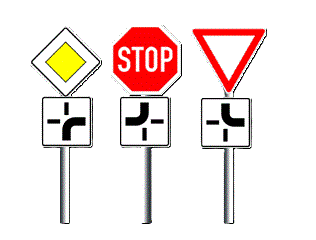
1) How Do We Read the Signs Correctly?
In driving school, there is one clear rule:
Always read signs from bottom to top.
Why?
Because the additional sign (below) explains how the main sign (above) must be understood.
Step-by-step method:
- Look at the bottom sign: Is there an additional sign with lines?
- Then look at the top sign: What is the main sign?
- Combine both: Additional sign + main sign = rule for this intersection
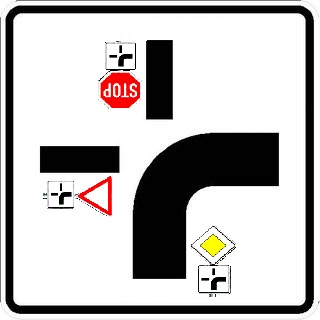
2) Which Signs Indicate a Curving Priority Road?
A) You are on the priority road
You see:
- The priority road sign (yellow diamond)
- Often with an additional sign showing lines below it
This means:
This is a priority road, but it does not necessarily go straight ahead.
It follows the direction shown by the diagram (lines).
B) You are NOT on the priority road (coming from a side road)
You usually see:
- “Give Way” (Yield) sign
or - Stop sign
This means:
You are on a minor road and must give way to vehicles on the priority road.
3) How Do You Read the Additional Sign with Lines?
The additional sign is the map of the intersection.
Very important:
- Thick line = priority road
- Thin lines = minor roads / side roads
What exactly does the thick line tell you?
It shows:
- From where to where the priority road runs
- Whether it bends left or right
- Whether you stay on the priority road or leave it
Test reminder:
“The priority road follows the thick line.”
Not “straight ahead”, not “where you’re looking”, but where the thick line goes.
4) How Do You Know Whether You Stay on or Leave the Priority Road?
This is the most important part.
Step 1: Imagine you are the bottom point of the diagram
You always enter the intersection from your direction.
Step 2: Find the thick line connected to your road
If the thick line belongs to “your” road, you are on the priority road.
Step 3: Follow the thick line mentally
Does it lead left or right?
Then the priority road bends in that direction.
Result:
- You follow the thick line → you stay on the priority road
- You do NOT follow the thick line → you leave the priority road
5) Who Has Priority – The Logic Behind It
Case A: You stay on the curving priority road
- You have priority over all vehicles from side roads (thin lines, yield/stop signs)
BUT:
If two vehicles are both on the priority road (both follow the thick line), they are both prioritized over side roads,
but they still must coordinate with each other (paths may cross, eye contact may be necessary).
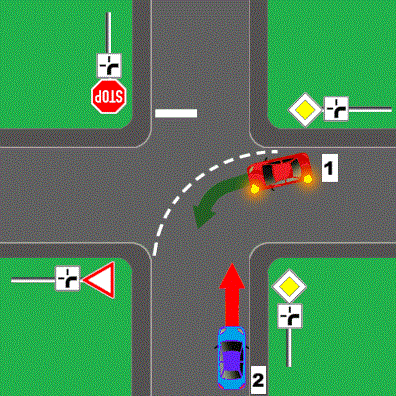
Case B: You leave the priority road (classic test trap)
If the thick line bends, but you drive straight ahead:
- You are no longer on the priority road
- You enter a minor road (thin line)
Result:
You may have to yield to vehicles that stay on the thick line.
Important rule:
“Driving straight ahead can mean leaving the priority road.”
6) Signaling – Correct, Consistent, Test-Safe
Many learners think:
“The road bends, not me.”
That is wrong.
In the test, your driving direction matters.
Rule:
- If you change direction → use your indicator
- When leaving the priority road, you must also signal, because you behave like a turning vehicle
Examples:
- Thick line bends right → signal right
- Thick line bends left → signal left
- Thick line bends, but you drive straight (leave it) → signal, because you are leaving the priority road
In driving tests, signaling is usually expected when leaving the priority road.
7) Entering a Curving Priority Road from a Side Road
Often underestimated:
If you come from a side road and see Yield or Stop, and the priority road bends:
You must:
- Yield to ALL vehicles on the thick line
- No matter if they come from the left, right, or opposite direction
You don’t wait for directions —
you wait for the priority road (thick line).
Test reminder:
“I don’t wait for directions – I wait for the thick line.”
8) Step-by-Step Method for Every Curving Priority Road (Test Scheme)
Always do this:
- Read signs from bottom to top
- Identify the thick line (priority road)
- Determine your position in the diagram
- Decide: Do I stay on the priority road or leave it?
- Signal accordingly
- Check early who is on the thick line
- Drive only when the priority situation is clear
9) Typical Test Trap
Situation:
The priority road bends left (thick line left). You want to drive straight ahead.
Wrong:
“I’m driving straight, I have priority.”
Correct:
“I am leaving the priority road → vehicles staying on the thick line have priority.”